
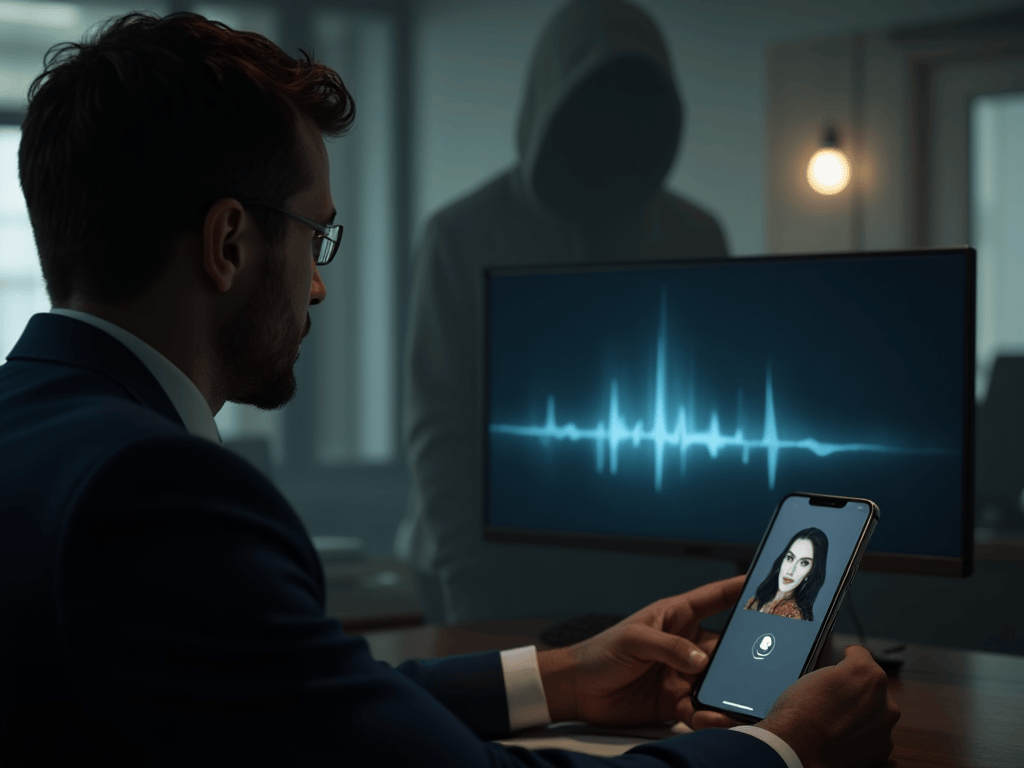
Introduction – A Voice You Know… Or Do You?
Consider such scenario: you answer a phone call, and you hear the voice of your boss, which sounds very worried and anxious, because he needs you to make a transfer of funds to commit to an important deal. You obey, relieving assurance in the tone. It is deepfake but you only know it later. Just the mere thought makes my hair stand on end–and it ought to make yours turn up on end as well. Deepfake phishing with voice has become science fiction nightmare to boardroom nightmare. Single Q1 2025 has already accrued documented financial losses of deepfake scam alone, which numbers to hundreds of millions and is increasing rapidly. Scary? Absolutely. However the threat is substantial and the best place to start in defence of our online lives is learning the mechanics.
The Deepfake Vishing Playbook
Not only Vishing-Deepfake voice fraud has become a permanent part of the arsenal of criminals. Now these scams are simulating voice cloning, usually of an executive or a relative, to again jaw-dropping authenticity utilizing AI. In less than 10 seconds of recordings of a voice, criminals can reproduce pitch, lisp, even heartbreaking tones.
A single CEO almost sent out almost a quarter of a million dollars because he was tricked into believing the voice he heard was that of his managing director- until a crosschecking measure came in to rescue the company. In yet another chilling attempt, a Hong Kong based engineer transferred 25 million on a video call where several executives sounded on the video call through AI generated voices. These aren?t flaws but are wake-up calls about the trustworthiness with which AI can deceive.
Why Are We So Susceptible?
It has psychological factor we cannot disregard. Voices have authority, familiarity, urgency. It is our biological nature to react. And as AI introduces a choreography of soul– mimicking inflection, tone, even dithering- the ring becomes almost complete.
The following is what makes deepfakes vishing especially threatening:
- Stolen samples that sound like voices even spoken–with only the briefest snippet of recorded sound, cloning can sound believable.
- Unavailability of verification machinery– unlike email which has spam filters or has the sender be authenticated, phone-based AI deception usually escapes precautions.
- Advanced targeting– the attackers scan the public profiles and make it more personal and believable.
It is not only corporations. This type of fraud occurred in India when a retiree was deceived when hearing the sound of a desperate voice that he thought belonged to one of his relatives pleading to get his help. This use of deepfake to conduct vishing is terrifying because it has reduced to an emotional weapon.
National Security at Risk
What would occur when this runs bigger than people and companies? Institutional trust dries up. In the recent past, state authorities have been on alert of voice calls done by using artificially intelligent tools mimicking high-ranking leaders. An AI-cloned voice tried to imitate a senior U.S. diplomat in contacting foreign parties in one high-profile case.
In case stolen voices are able to break communications in a nation, then the stakes will be much higher. What evades detection is that these attacks develop the relationship, then strikes. This is not an exercise in hypotheticals, though, we’re talking erosion of institutional confidence and that is a systemic risk.
Professional Opinion & Biography
I have passed enough time in cybersecurity scenes to learn this: that the technology is not where the problem begins–rather, it is our tendency to submit to those in positions of authority over us, all the more so when the way they assert this authority is in form of something that we already understand and accept on that: speed.
Research indicates that the majority of human beings are not able to recognise the capable distinction between spoken language and AI-generated voices. There is development of detection mechanisms, including audio water marking and real time authentication, but we are at the beginning stages. The most worrying factor to me is not the advancement of the technology, but the speed at which we are ready to surrender trust once heard a familiar voice.
Defense Strategies: Beyond Tech
What can be done now by businesses and individuals is this:
- Use secondary verification mechanisms–when someone calls and says that he or she is your boss, have him or her send an official email or use a pre-determined code word.
- Educate workers and family members-make it normal to question urgency, even when a voice sounds very real.
- Use detection software– Companies are starting to implement deepfake detection software programs that m be able to sound the alarm on suspicious audio.
- Make voice skepticism institutional, i.e., the norm to doublecheck first, before taking any action based on what we heard.
Companies which embrace multi-layered verification, such as the incorporation of emotional awareness with the implementation of technology, will have far better chances of surviving the deepfake era.
Conclusion – A Thought to Carry Forward
This is the harsh reality, we can no longer take it to be true that what we hear is true. With the ability to fake voices- the closest form of human bond- what foundation can we rely on? It is only a combination of skepticism, intelligent systems and social training which will help restore our lost reliability.
Instead of fighting the same fight, let us turn the story around: train people to say, that it sounds too urgent to neglect, but I will check it out first. It is only when that happens that we can stem the tide of deepfake vishing– and regain the trust of our words– and our voices.