
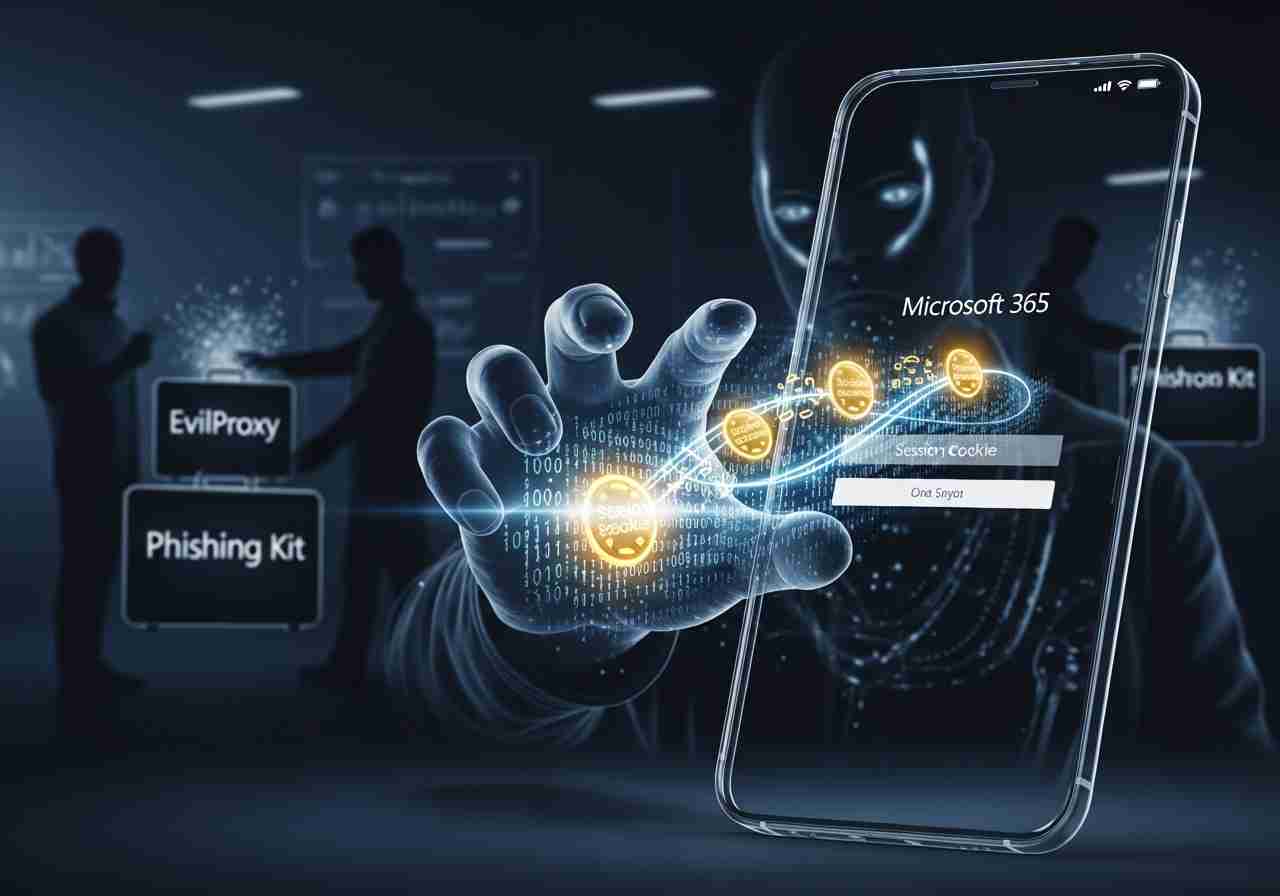
Brutally honest with each other. To what extent are you confident about your multi-factor authentication? MFA was the silver bullet as we were all told. It put a freeze on the credential stuffing. The game has changed drastically though. MFA is becoming virtually useless due to a new type of phishing kits, offered as software on the dark web. These are not the ugly fake logins of your cousin. These are advanced online proxies. They do a live heist of all of your authenticated session. The technological environment has just become very unsafe. This turn has to be grasped.
The Invisible Middleman Anatomy of a Modern Heist
Picture this: persuasive mail on a common document. You click, looking now at an ideal Microsoft 365 log-in page. Your details are entered. The MFA drive is delivered to your mobile phone. You approve it. You are on your old dash board. Nothing seems amiss. But you have been out right robbed now. The following is the horrifying mechanics. That page was a live proxy. Your typing keys were a direct connection to the server of a criminal. That server passed them on to the actual Microsoft. It went to an extent of passing over the actual sign-in page. You were basically making the attacker a guest. They stole your session cookies, and not your password only. Golden tickets they are cookies. They offer unrestricted access, which never requires MFA to be used again.
The threat analysts of Microsoft explain it very clearly: They steal passwords, steal sign-in sessions, and get around MFA with the help of AiTM infrastructure.
Such kits are frighteningly workable. They form a smooth evil connecting. The interface is a natural experience. That’s their genius. They take advantage of our faith in the established log-in process. There is a scramble in the Cybersecurity community. The training on checking the URLs old is not working. These proxies are capable of displaying the legitimate domain too briefly.
The Boom of Crimeware-As-A-Service: It requires a new IT Response
Who builds these tools? Not the attackers using them. We are experiencing an underground economy on a professional level. Special developers create and support web proxy kits such as EvilProxy or MysterySniff. They offer customer support. They keep on updating themselves to avoid detection. A threat actor can rent this capability for several months at a few hundred dollars per month. This is Phishing-as-a-Service. It reduces the entry barrier to high impact attacks. Crimes with low skills are now capable of carrying out high profile campaigns.
Recent data is alarming.
- A report recorded a 200 percent increase in the use of AiTM by crime groups.
- There are more than 50 brands that Kits are targeting, including AWS and LinkedIn.
- Piping of stolen cookies is common to be used immediately into Telegrams.
It is a commodification that transforms it. Defense no longer has individual actors. We must attack the typical methods these kits use. Our IT policies must assume that attackers will steal any credentials. We should switch to authenticating the context of each login session.
A True-Life Story: The Great Token Drain
Let’s make this concrete. It is still fresh in our minds, the Caffeine phishing platform. Security company Proofpoint described their operation. It was an affiliate service point and click. The target of the users was Microsoft 365 accounts worldwide. Bulletproof hosting was used in the kit. It used cloud infrastructure to appear credible. Above all, it computerized the whole process of stealing cookies. The success rates were terrifying. This wasn’t a nation-state. It was an online criminal enterprise, streamlined to make money. It demonstrated AI’s capability, showing that even these groups could use it to optimize lures or control infrastructure.
The Expert Lens: Why This is Different
I interviewed a lead threat hunter who deals with these cases on the weekly basis. I shivered at their point of view. There are no old signs any more, said they. The URL might be right. The SSL certificate is valid. The system displays the actual MFA prompt to the user. The session has become the point at which it fails. We are fooling ourselves out of our identity systems. The system then passes that trust over to the attacker. It would need a re-thinking. It has taken us years to put walls round the front gate. The attackers are currently taking our invitation to have a walk through it.
Constructing a Brawny Defense: Not the User Fault
So what do we do? First, cease accusing the user, who fell victim to a phishing email. These kits are too good. The human will never be the strongest. We need to develop systems, which presume that a link is to be put into action. The following is your new priority list.
Switch to MFA phishing resistance. Security keys (FIDO2) or windows hello (mandatory). These techniques apply cryptography not interceptible by a proxy. They represent the largest deterrent.
Impose severe Conditional Access. Block access on foreign countries. Who needs a company-controlled, law-abiding device. Criminals should not be able to work anywhere.
Implement real time tracking of sessions. Purchasing empires that detect simultaneous logins in Nigeria and Nebraska. They are capable of destroying suspected sessions before the damage is experienced.
Isolate risky web browsing. Render web pages by using remote container technologies. This prevents the malware as well as the theft of cookies locally.
The Discomforting Reality and Way Forward
Here’s my strong opinion. The emergence of AiTM kits is not another threat. It’s a market signal. It informs us that the age of passwords and one-time codes is gone. The criminals invest in the area that is high in return. Our present controls are bankrupt as evidenced by their investment in this ecosystem. It is a broken model that we are defending. The change in architecture is no longer a matter of another awareness campaign, but a change in cybersecurity leadership. This is concerning taking an identity-based, zero-trust pose with stolen credentials being powerless. The proxy attack is a mirror. It reflects us in our outmoded image. It is time to break that mirror and create something different. Whether your MFA will be circumvented or not is not the question. It’s when. Are you going to have a prepared IT environment?