
The Lab of the Future Runs on AI
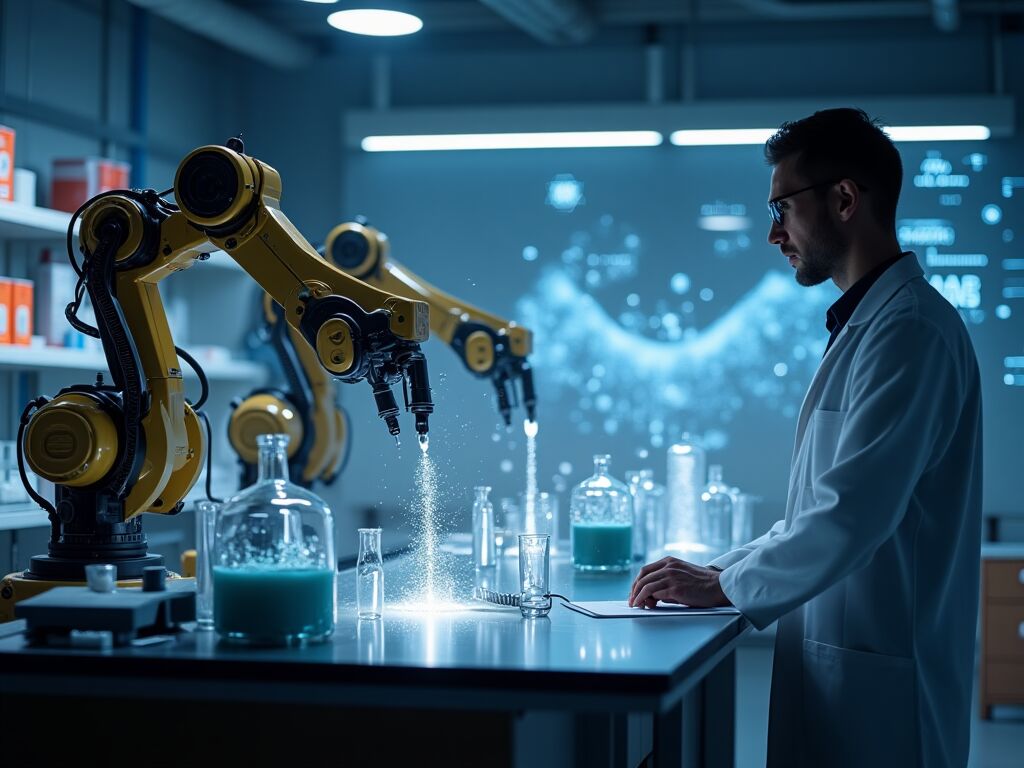
Imagine: a lab with 24-hour experiments, a robot capably and precisely mixing chemicals and AI accurately predicting solutions that deliver breakthrough drugs even before a human scientist has begun exploring a pipette. It is not the scene of a sci-fi movie this is what is being experienced. The pharmaceutical industry has forever been plagued with lengthy and costly trial and error studies, and robotic chemists are helping this industry undergo a radical change. These AI-enabled labs are cutting down drug development time that used to take decades to months and the consequences are mind-boggling.
However, the game changer is that a robotic lab in the UK has just unearthed a new antibiotic in only 48 days whereby traditionally years are required. How? Making use of automated chemistry and machine learning together. Not whether the AI will transform drug discovery- it already has. The point is in reality: How much is this going to go?
How AI and Robotics Are Rewriting the Rules of Chemistry
The days in which hundreds of thousands of chemical assays had to be done painstakingly and with errors by clueless chemists have long since passed. Tomorrow, using AI-driven robotic transformers, such as IBMs RoboRXN or the autonomous labs developed at MIT, you will be able to predict how molecules will act, synthesize compounds and even optimize reaction without human action.
- An example: A team of researchers at the University of Liverpool has been working with an AI chemist to investigate 100,000 possible chemical reactions within a seven-day period that would have taken literal years to a human scientist.
- Robot Labs are taking off: Pfizer and Novartis are now operating in robot labs through high-throughput screening which reduces failed experiments by up to 70 percent (Nature Robotics, 2024).
The twist is, however, that AI does not simply make your processes faster: it finds paths that humans would not even look at. Consider DeepMinds protein-structure predictor, AlphaFold. It was not the simple reproduction of the human knowledge, but added up to 200 million protein structures at a single attempt. To me, that is the power of machine learning: not only it helps science, but it changes it.
Real-World Impact: From COVID-19 to Cancer Breakthroughs
The pandemic was a change of attitude. Traditional drug discovery is time consuming when COVID-19 struck. In comes AI-powered labs. Moderna and BioNTech turned to robotic systems to optimize a mRNA sequence quicker and faster than ever, cutting months off the whole process in order to make vaccines.
And yet the actual game-changer? Personalized medicine. Think of the cancer patient receiving in weeks rather than years a drug tailored to his or her tumor. It is doing so already:
- A program at UC Berkeley was able to synthesize a custom case of leukemia treatment in only six weeks at the robotic lab.
- The design of a fibrosis drug candidate using robotics took place in less than 18 months at Insilico Medicine, an AI biotech company, which normally takes 4-5 years.
The point is simple: AI is not taking over the role of the scientists it provides them with super powers.
The Dark Side: Can We Trust Robots with Medicine?
Not all people are cheering. Other authorities caution that black box nature of AI, i.e. decisions are reached without human comprehension, may result in fatal carelessness.
- In the blunt wording of Dr. Sarah Richardson (MIT): “AI can come up with a thousand drug candidates, but which one will not kill you? There is where man comes in.”
- Regulatory challenges: As the FDA continues to find ways of how to assess AI-discovered drugs, there would be questions of safety and responsibility.
Then the debate then there is the job. Will the human researcher become defunct because of the robotic chemists? Probably not. Rather, they will change jobs positions- manual operation to much, careful planning. Someone has to ask the right questions, after all-albeit the answers might be found by the robot.
What’s Next? A self-driving Lab even in every Pharma Firm?
It is competitive. Fledgling companies such as Cradle (Netherlands) and Deep Genomics are developing completely independent labs, with Big Pharma throwing cash into the opportunity. According to McKinsey, AI will support 50 percent of early-stage drug research by 2030.
The big question however, is whether or not this should be open-source. In case robotic chemists become widely affordable, it might result in a democratization of drug discovery that is, the drug-discovery activities of universities and small laboratories compete more directly with the giant firms.
Final Verdict: A Faster Future—But at What Cost?
There is no denying the fact that machine chemists would transform medicine forever. They are faster, cheaper and they can even be smarter than human beings. However, with the increasing amount of control that we transfer to machines, we have to pose the question: Are we exchanging efficiency with serendipity? Accidents led to some of the greatest findings such as penicillin. Will AI have human error?
The one thing that is definite is that the lab of the future will not be a human against the robot but human and robot. The issue becomes how do we get that partnership going?
It seems to me. Do we even really expect stricter control of AI-based drug-discovery? Or is haste not worth going? Let’s debate.